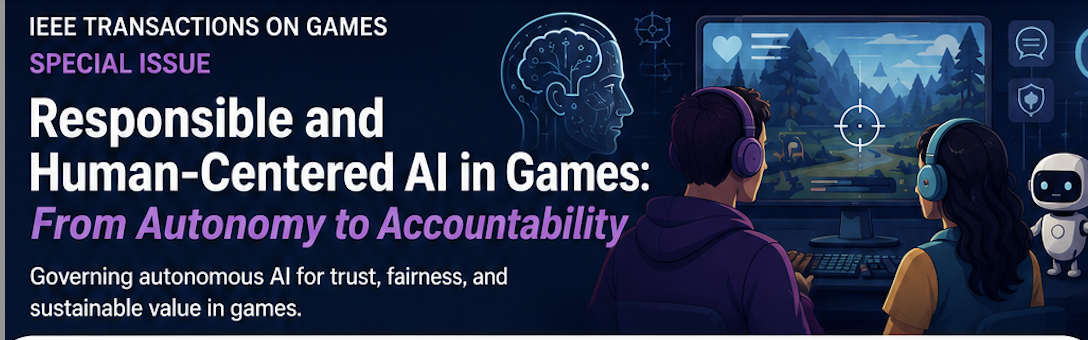
Special Issue on Responsible and Human-Centered AI in Games: From Autonomy to Accountability
Special Issue on Responsible and Human-Centered AI in Games: From Autonomy to Accountability
Overview
Artificial intelligence is rapidly transforming digital games and the organizations and platforms that create, operate, and govern them. AI is embedded in many aspects of game design and development, including procedural content generation, player modeling, personalization, matchmaking, moderation, recommendation, playtesting, and monetization. More recently, generative and agentic AI have extended these capabilities toward increasingly autonomous content creation, interaction, adaptation, and decision support.
The central challenge is no longer simply what AI can do for game development, but how to design, manage, and govern increasingly autonomous AI when its decisions affect players, creators, organizations, and gaming ecosystems. As AI assumes greater responsibility for creating content, making recommendations, moderating behavior, adapting experiences, and supporting organizational decisions, questions of human agency, oversight, trust, fairness, transparency, privacy, and accountability become increasingly important.
This Special Issue examines responsible and human-centered approaches to AI in games, with particular emphasis on the allocation of authority between humans and AI. We seek research that explains when AI should act autonomously, when humans should intervene, how decision rights and accountability should be allocated, and how governance mechanisms shape player and organizational outcomes. We seek contributions on the use of AI and the exploration of related issues at multiple levels, including the organizational and individual levels. We thus welcome industry contributions as well as academic research.
Aim and Scope
The Special Issue aims to establish games as an important context for studying responsible and human-centered AI, while bringing together research from game AI, human-computer interaction, artificial intelligence, information systems, organizational studies, technology management, innovation, behavioral research, and platform governance.
We particularly welcome research organized around five interconnected themes:
- AI Autonomy and Human Control — human-in-the-loop and human-on-the-loop systems; AI autonomy; intervention; delegation; and allocation of decision rights.
- Human–AI Collaboration in Game Creation — AI-supported design, development, creativity, procedural content generation, testing, production, and organizational workflows.
- Transparency, Explainability, and Trust — explainable AI, algorithmic transparency, player and developer trust, perceived fairness, contestability, and communication of AI decisions.
- Governance, Accountability, and Responsible Innovation — accountability structures, privacy and data governance, algorithmic fairness, moderation, monetization, responsible personalization, failure response, and organizational governance.
- Player, Organizational, and Ecosystem Outcomes — player agency, welfare, engagement, retention, legitimacy, reputation, innovation, business performance, platform governance, esports, and sustainable value creation.
We welcome research that explores:
- How should authority and decision rights be allocated between humans and increasingly autonomous AI systems in games?
- When does human oversight improve the quality, legitimacy, trust, and acceptance of AI-supported decisions—and when can intervention create costs or unintended consequences?
- How do transparency and explainability influence player agency, trust, perceived fairness, and organizational decision-making?
- What organizational and governance capabilities enable gaming firms and platforms to deploy generative and agentic AI responsibly?
- How does human–AI collaboration affect creativity, innovation, productivity, and decision quality in game development and operation?
- How do governance arrangements influence player welfare, engagement, retention, organizational legitimacy, reputation, and business or platform performance?
Important Dates:
- Paper Submission Deadline: October 31, 2026
- Completion of First Round of Review: April 30, 2027
- Completion of Final Review: May 31, 2027
- Submission of Final Manuscripts: June 30, 2027
- Tentative Publication: August 2027
Submission Information:
We invite high quality submissions in one of these formats:
- Full papers (10-14 pages including references and appendix; IEEE/journal fees apply for pages over 10)
- Short papers (6-8 pages including references and appendix; IEEE/journal fees apply for pages over 6)
- Letters (4-5 pages including references; IEEE/journal fees apply for pages over 4)
Authors should follow normal IEEE Transactions on Games guidelines for their submissions but identify their papers for this special issue during submission. Extended versions of previously published conference or workshop papers are welcome, provided the journal paper is a significant extension accompanied by a cover letter explaining the additional contribution. See here for author information guidelines and page length limits.
Guest Editors:
- Sandip Rakshit (lead editor) — Rabat Business School, Université Internationale de Rabat, Morocco
- Tripti Paul — Rabat Business School, Université Internationale de Rabat, Morocco
- Emily Chen — Department of Computer Science and Engineering, University of California, Santa Cruz, United States